
Compare
A caterer or a restaurant marketplace?
Marketplaces connect you to many restaurants through one ordering platform. A catering company cooks everything in its own kitchen and can staff events. Both are good at different things, and plenty of Toronto offices use both.
How each model works
A restaurant catering marketplace is a platform that lists catering menus from many partner restaurants. You order through the platform's website or app, often with tools for budgets, individual employee ordering and consolidated invoicing. The food is cooked by the restaurant you chose and delivered by the restaurant, the platform or a courier. Several of these platforms operate across Toronto and the GTA, especially for office lunches.
A catering company plans the menu, cooks in its own kitchen, and delivers or serves the food with its own team. The same business handles a Tuesday boxed lunch, a client reception and a holiday party, and the same kitchen is responsible for every dish.
Where marketplaces are strong
It is worth being straightforward about what marketplaces do well.
- Variety. Dozens of cuisines and restaurants, so a weekly office lunch can rotate without anyone getting bored.
- Individual ordering. Many platforms let each employee pick their own meal within a budget, which suits hybrid teams with different tastes.
- Ordering tools. Online menus with published prices, saved addresses, budget controls, reporting and one invoice across many vendors.
- Familiar names. Staff may recognize and like the restaurants on offer.
- Short-notice ordering. Depending on the platform and restaurant, some orders can be placed with little lead time.
| Factor | Restaurant marketplace | Catering company |
|---|---|---|
| Who cooks | Many partner restaurants | One catering kitchen |
| Menu range | Very wide, many cuisines | Narrower, customizable |
| Consistency across orders | Varies by restaurant | Same recipes and process |
| Dietary and allergen handling | Depends on each restaurant | One labelling and allergen process |
| Ordering | Online platform, often individual ordering | Proposal, email or order form |
| Published prices | Usually | Varies; ours are on our pricing page |
| Staffed events and rentals | Rarely | Yes |
| Accountability | Shared between platform and restaurant | One business |
| Best for | Everyday variety, individual choice | Events, client meetings, consistent programs |
Where a catering company is strong
- One accountable kitchen. If something is wrong, the people who cooked it are the people you talk to. There is no hand-off between platform, restaurant and courier.
- Consistency. The same recipes, portions and packaging each time, which matters for recurring programs and client-facing meetings.
- Dietary process. One allergen and labelling process across every dish. With many restaurants, dietary handling depends on each kitchen's own practices, which vary.
- Events, not only deliveries. Staff, rentals, passed canapés, stations, plated dinners and venue logistics. Most marketplace orders are delivery-only.
- Custom menus. A menu built for your event, group size and dietary mix, rather than a restaurant's fixed catering list.
- Planning help. Advice on quantities, timing and format for the event, not just the order.
Food built for catering
Restaurant food is designed to be eaten minutes after it leaves the pass. Catering food is designed to travel, hold and still be right 30 to 90 minutes later. Some restaurants adapt their catering menus well; others send dishes that suffer in transit, like fries, delicate fish or dressed salads. A catering kitchen plans every dish around holding time and packaging from the start. Ontario's Food Premises regulation (O. Reg. 493/17) applies to both, with food held at 4°C or colder or 60°C or hotter, but how well a dish survives the trip is a menu design question.
Recurring lunches: where the difference shows
The two models feel most different over months, not on a single order. On a marketplace, a weekly lunch rotates through different restaurants, which keeps things interesting but means packaging, portion size, labelling and delivery timing change from week to week. Someone on your side usually ends up checking each new restaurant's dietary options.
With a caterer, the rotation happens inside one kitchen's menu. Variety is narrower, but the halal, vegan and gluten-free meals come labelled the same way every week, headcount changes go to one contact, and the invoice looks the same each month. For teams where a few people rely on those dietary meals, that predictability is often the deciding factor.
Pricing and fees
Marketplaces often publish per-person prices clearly and add delivery or service fees at checkout. Catering companies vary: some quote only on request, and some, like us, publish starting prices on a pricing page and list delivery, staff and service charges separately.
When comparing, line up the all-in cost for the same headcount: food, delivery, any platform or service fee, disposables, staff if needed, and 13% HST. Headline per-person prices are hard to compare on their own.
Questions to ask either option
- Who is responsible if an order is late, short or wrong, and how is it fixed on the day?
- How are dietary and allergen requirements handled, labelled and kept separate in the kitchen?
- What are the lead time, cancellation deadline and minimum order?
- What is the full cost for our headcount, including all fees and HST?
- Can you provide staff, rentals or a certificate of insurance if our building or venue needs them?
Choose a marketplace if / choose a caterer if
Choose a restaurant marketplace if:
- Variety across many cuisines is the priority for regular team lunches.
- You want each employee to order individually from an app.
- You need delivery only, with no staff or event service.
- Platform budget controls and reporting matter to your finance team.
Choose a catering company if:
- You want one kitchen accountable for quality and dietary handling every time.
- Your orders include client meetings, receptions, holiday parties or other staffed events.
- You need a custom menu or serious allergen control.
- You want consistent food for a recurring lunch program.
Many companies use a marketplace for everyday variety and a caterer for events and client-facing meals. That is a reasonable split.
Questions
Frequently asked
Is a catering marketplace cheaper than a caterer?
Not necessarily. Menu prices overlap, and fees vary on both sides. Compare the all-in cost for the same headcount, including delivery, service or platform fees, disposables and 13% HST.
Can a marketplace handle a staffed event?
Most marketplace orders are delivery-only. For servers, bartenders, rentals or a plated dinner, a catering company is usually the right choice.
Which is better for dietary restrictions?
A single kitchen with one labelling and allergen process gives more consistent control. On a marketplace, dietary handling depends on each restaurant.
Can we use both?
Yes. Many companies use a marketplace for everyday team lunches and a caterer for client meetings, receptions and holiday parties.
Do you offer recurring office lunch programs?
Yes. See our recurring programs page for how we plan menus, headcount changes and invoicing for regular orders.
Keep planning
Related pages

Catering options, compared honestly
Most catering decisions come down to a handful of trade-offs between cost, staff, space, time and how guests eat. These comparisons put the…
Explore
Corporate catering in Toronto and the GTA
Food for the working day and the evenings around it: breakfast meetings, team lunches, all-day conferences, weekly meal programs and client…
Explore
Recurring office meal programs
Weekly or daily team lunches on a rotating menu, with a standing dietary roster, a clear headcount cut-off and one consolidated invoice.
Explore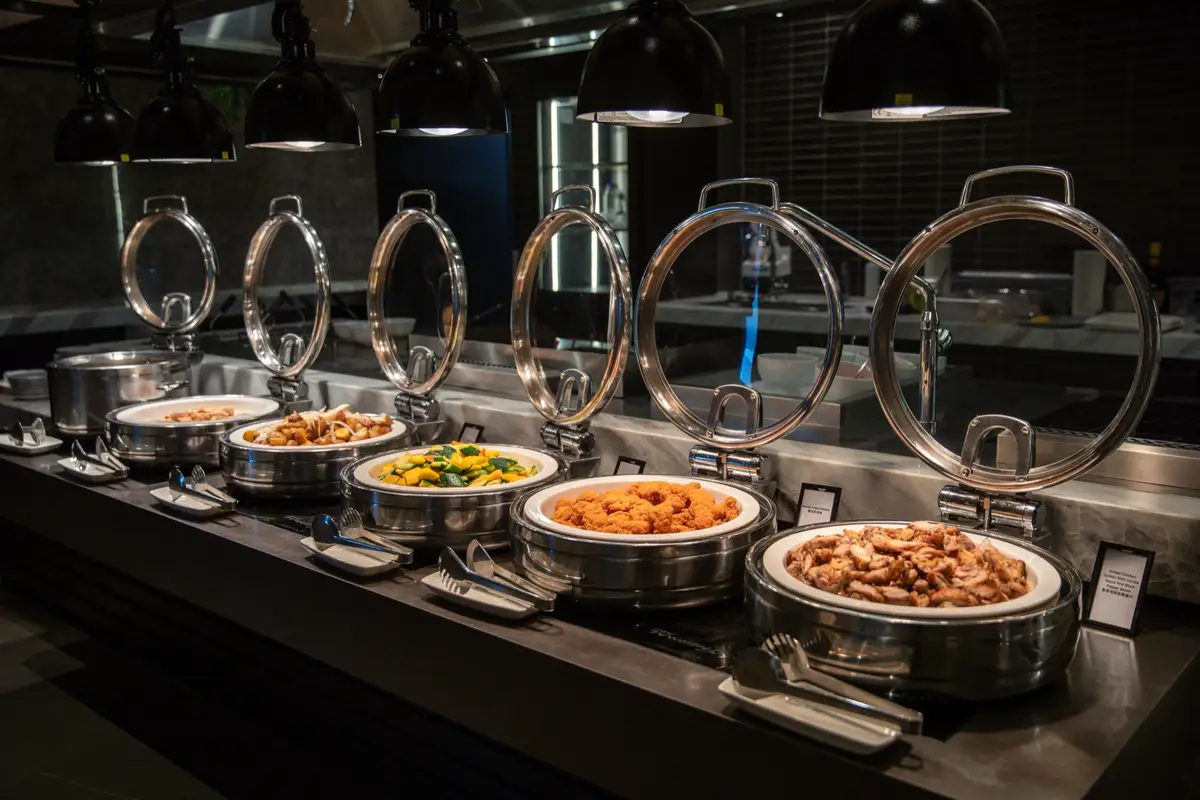
Office lunch catering
Hot buffets and shared platters for team lunches, lunch-and-learns and working sessions, delivered to your floor, set out with labels and ready when…
Explore
Catering prices
Starting prices per person for every format, plus every fee that can appear on a quote: delivery, staff hours, service charge, rentals and HST. No…
ExploreWhat corporate catering costs in Toronto, per person
Industry guides put Toronto office catering at roughly $5–$15 per person for breakfast, $20–$50 for lunch and $50–$150 for evening receptions. The…
Read the guide