Costs and budgets
What corporate catering costs in Toronto, per person
Industry guides put Toronto office catering at roughly $5–$15 per person for breakfast, $20–$50 for lunch and $50–$150 for evening receptions. The per-person menu price is only part of the bill, so this guide walks through every other line and two worked examples.

The short answer: ranges by format
Corporate catering in Toronto is priced per person, and the format decides most of the number. A continental breakfast and a staffed client reception can both be "catering for 60", yet one costs ten times the other. The table below uses published ranges from Toronto sources so you can sanity-check any quote you receive, including ours.
| Format | Typical Toronto range per person | Source |
|---|---|---|
| Breakfast and coffee breaks | $5–$15 | elle cuisine corporate cost guide 2025–26 |
| Corporate lunch (boxed, platters, hot buffet) | $20–$50 | elle cuisine corporate cost guide 2025–26 |
| Dinner and evening receptions | $50–$150 | elle cuisine corporate cost guide 2025–26 |
| Non-alcoholic beverage add-on | $10–$30 | elle cuisine corporate cost guide 2025–26 |
| Office and marketplace catering overall | $15–$75 | LunchLink Toronto corporate catering page |
These are before HST and before service costs. Our own starting prices sit inside those ranges: breakfast from $16 per person, boxed lunches from $24, a hot lunch buffet from $32 and canapé receptions from $38. The full sheet, with what each price includes, is on our pricing page.
What the per-person price usually covers
A per-person price covers the food and the things that travel with the food. For drop-off orders that normally means the menu itself, serving utensils, disposable plates, cutlery and napkins, and dietary labels. For a hot buffet it usually adds chafing dishes and fuel. It rarely covers anyone standing in the room.
What it does not cover is anything priced by the job rather than by the guest: the delivery run, staff hours, a service charge on staffed events, rentals such as linen and glassware, and tax. Two quotes at $30 per person can land $400 apart once those lines appear, which is why comparing menu prices alone is the most common budgeting mistake we see from office managers.
Ask every caterer the same question: "What is my all-in total, including tax, for this headcount at this address?" A good caterer answers in one number and shows the lines underneath it.
Compare corporate catering quotes line by line
- Is the per-person price for the exact headcount you gave?
- Are disposables, serving utensils and dietary labels included?
- What is the delivery fee for your address and time slot?
- How many staff, for how many hours, including setup and teardown?
- What is the service charge percentage and what does it cover?
- Which lines is 13% HST applied to?
- When is the final headcount deadline and what happens after it?
- Is there a rush fee for orders inside the standard lead time?
- Does the building need a certificate of insurance or a dock booking?
Every fee that can appear on a corporate quote
Delivery
Delivery is charged per drop, not per guest. Ours starts $45 within the core area; LunchLink, a Toronto office-catering marketplace, lists a $40 delivery fee as typical. Expect more for early drops (before 7:30 a.m.), timed deliveries to a specific floor, or addresses outside the city where the round trip on the 401 or the QEW can run over an hour.
Staff hours
Once people stay on site to set up, serve, replenish and clear, you pay for their time, usually with a minimum shift (four hours is common) that includes setup and teardown. Our staff rate is $38 per staff hour. LunchLink quotes about $18 per staff hour on its platform, which reflects a lighter attendant role; a trained event server or a chef running a station costs more. The number of staff depends on the format, covered in our guide to staffing ratios.
Service charge
Full-service events usually carry a service charge on top of food and staff. Ours is 18%. The elle cuisine guide reports 15–20% as the common range for evening events in Toronto. It pays for the planning, coordination and operational overhead behind a staffed event. Ask what it covers and whether it is shared with staff, because it is not the same thing as a tip.
Rentals and disposables
Drop-off orders use disposables, which are normally in the price. LunchLink lists about $0.50 per person for disposables where they are charged separately. A reception in your office lobby or a client event in a rented space may need linen, china, glassware, high-top tables and a coat rack, all billed by the item from a rental company.
HST
Catered food and beverages in Ontario carry 13% HST (5% federal plus 8% provincial). The Canada Revenue Agency's guidance on the convention and hospitality industry confirms that platters, hot meals, beverages and other supplies made to cater a function are taxable. Ontario's point-of-sale rebate on prepared food only applies to sales of $4 or less, so it never applies to a catering order. Check which lines of your quote the tax is applied to.
Rush and change fees
Orders placed inside the normal lead time (48 hours for drop-off with us) and headcount changes after the confirmation deadline can carry a surcharge, or simply limit the menu to what the kitchen can buy and prep in time.
Worked example 1: a 40-person team lunch, drop-off
The figures below are illustrative round numbers inside the published Toronto ranges, not a quote. They show how a menu price becomes an invoice.
| Line | Calculation | Amount |
|---|---|---|
| Hot lunch buffet | 40 guests × $30 | $1,200.00 |
| Delivery, downtown office | One drop | $50.00 |
| Disposables and chafing setup | Included in menu price | $0.00 |
| Subtotal | $1,250.00 | |
| HST 13% | On subtotal | $162.50 |
| Total | $35.31 per person | $1,412.50 |
The gap between the $30 menu price and the $35 real cost is small because nobody stays on site. That is the main reason internal lunches are usually drop-off: food arrives hot in insulated carriers, is set on chafers with labels, and your team eats within the two-hour window that food safety guidance allows for hot food out of temperature control.
Worked example 2: a 120-guest client reception, fully staffed
Now a two-hour after-work reception with passed canapés in a rented space. Again, illustrative figures.
| Line | Calculation | Amount |
|---|---|---|
| Canapé menu, 10 pieces per guest | 120 guests × $45 | $5,400.00 |
| Staff: 1 captain, 5 servers, 2 kitchen | 8 staff × 5 hours × $40 | $1,600.00 |
| Service charge | 18% of food | $972.00 |
| Rentals: high-tops, linen, cocktail plates, glassware | Rental company invoice | $600.00 |
| Delivery and equipment van | Round trip | $120.00 |
| Subtotal | $8,692.00 | |
| HST 13% | On subtotal | $1,129.96 |
| Total | $81.85 per person | $9,821.96 |
The $45 canapé price nearly doubles once service is added. That is normal and it is why reception budgets should start from the all-in figure. Five hours of staff time covers one hour of setup, the two-hour reception and roughly 90 minutes of clearing and load-out, which is what a building with a single freight elevator really takes. Bar costs are separate again; see corporate receptions.
What pushes a Toronto corporate quote up or down
- Headcount. Menus are built for a typical group size. Ten people ordering from a 40-person buffet menu pay more per head because the fixed costs (delivery, setup, a chafer of each dish) are spread over fewer people.
- Proteins. Beef tenderloin, lamb and seafood move a menu up quickly. A vegetarian or chicken-led menu with one premium item keeps the per-person price down without looking thin.
- Individual packaging. Boxed lunches usually cost more than the same food on platters because of packaging and assembly time. They are worth it for mixed dietary groups, site visits and meetings where people eat at their seats. Our boxed lunches vs platters comparison goes through the trade-off.
- Building logistics. Financial District and PATH-connected towers often require booked loading-dock slots, security sign-in, a certificate of insurance and a freight elevator. That adds time on site and sometimes paid parking. One Toronto caterer's published guide (Big City Catering) suggests Financial District lunches run higher per head than North York or Scarborough; treat that as a single source, but the logistics behind it are real.
- Timing. Breakfast drops before 7:30 a.m., weekend events and the first three weeks of December cost more to staff.
- Dietary volume. Two or three labelled dietary meals cost little extra. Separate halal, vegan and gluten-free menus for a large share of the group add prep and packaging; our guide to dietary restrictions at office lunches shows how to keep that efficient.
Ways to lower the cost without it looking cheap
- Use drop-off for internal meetings and keep staffed service for clients and celebrations.
- Order platters, not boxes, when people will eat together in one room.
- Make a vegetarian main the default and add one meat option rather than two.
- Confirm the final headcount on the deadline, not a week early. Hybrid offices routinely see 10–20% of registered people stay home, and you pay for every meal ordered.
- Batch recurring orders. A weekly or monthly program can lower per-head pricing and removes rush fees. See our office lunch program guide and recurring programs.
- Book early in December season. Staff rates and availability are best when the date is locked by October.
For anything larger than a team lunch, send the date, headcount, address and dietary counts through our enquiry form and ask for an all-in estimate. We show every line, so you can compare it against the ranges above and against any other quote on your desk. The corporate catering overview explains each format in more detail.
Questions
Quick answers
How much should I budget per person for an office lunch in Toronto?
Industry guides such as elle cuisine put corporate lunches at $20–$50 per person before tax. For a drop-off lunch, add delivery and 13% HST; the all-in figure is usually $4–$7 above the menu price per person.
Is HST charged on catering in Ontario?
Yes. The Canada Revenue Agency treats catered food, beverages and the supplies made to cater a function as taxable, so 13% HST applies. The small point-of-sale rebate on prepared food only covers sales of $4 or less.
What is the difference between a service charge and a tip?
A service charge is a fixed percentage on the invoice that covers the cost of running a staffed event. A tip is voluntary. Ask the caterer what the service charge covers and whether any of it goes to staff.
Why is a boxed lunch more expensive than a buffet?
Individual boxes need packaging, labelling and assembly for every guest. The food cost can be the same as a platter, but the labour and materials are higher.
Do I need staff for a corporate lunch?
Usually not. Drop-off with chafers, labels and clear instructions works for internal lunches. Staff make sense for client-facing events, receptions and all-day conferences where food is replenished.
Is there a minimum order?
Most caterers set one. Ours is 15 guests for drop-off and 40 guests for staffed events.
Keep planning
Related pages

Catering prices
Starting prices per person for every format, plus every fee that can appear on a quote: delivery, staff hours, service charge, rentals and HST. No…
ExploreCorporate catering in Toronto and the GTA
Food for the working day and the evenings around it: breakfast meetings, team lunches, all-day conferences, weekly meal programs and client…
Explore
Boxed lunch menu
One sealed, labelled box per person: a main, a side and something sweet. Built for working lunches, site visits and teams where half the room has a…
Explore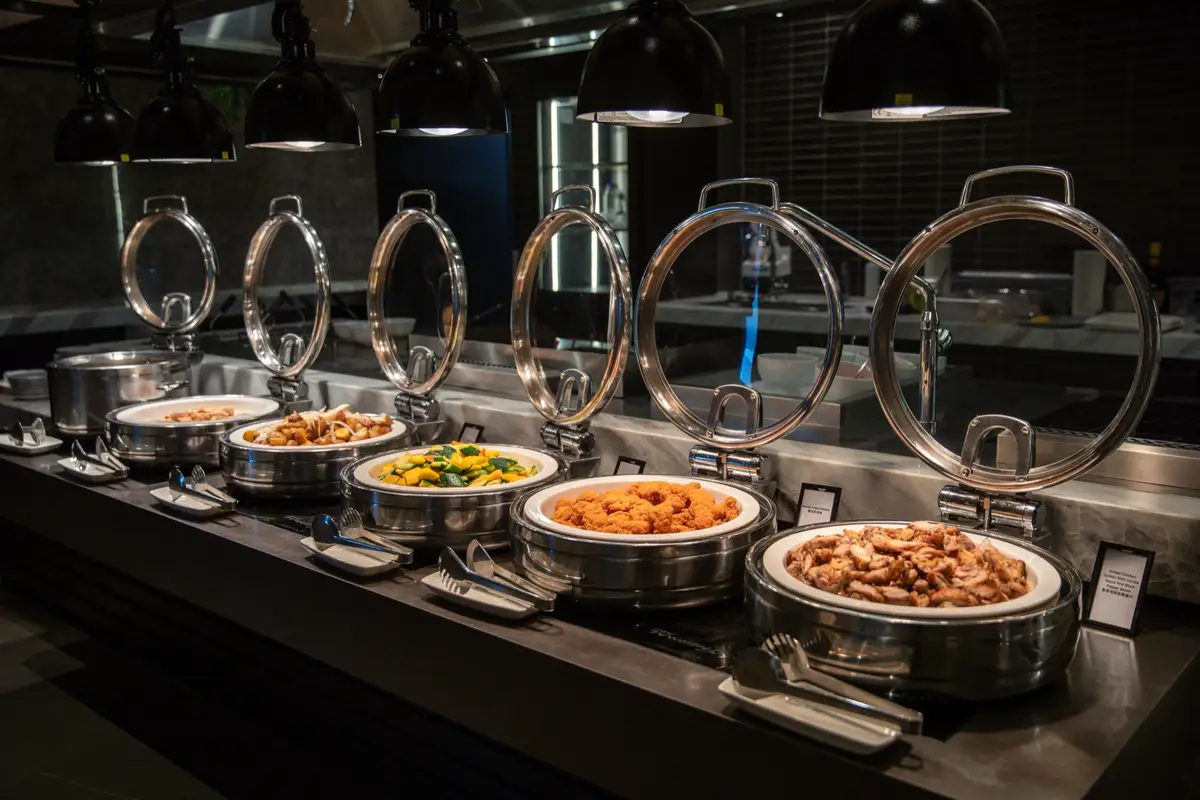
Hot lunch buffet menu
A shared hot meal for teams of 15 to a few hundred: two or three mains, a vegetarian main, sides, a salad and dessert, kept hot in chafing dishes on…
Explore
Drop-off catering
Food delivered ready to serve, set out on your table with labels and serving utensils, without the cost of staff staying on site.
Explore
Corporate event and reception catering
Canapés, food stations and grazing tables with full service for client receptions, product launches, open houses and awards nights across Toronto and…
Explore